Why the Way We Build Today Determines How We Live Tomorrow
For decades, architecture has followed a simple rule:
build fast, build solid, build functional.
Concrete. Steel. Glass.
Efficient — but disconnected.
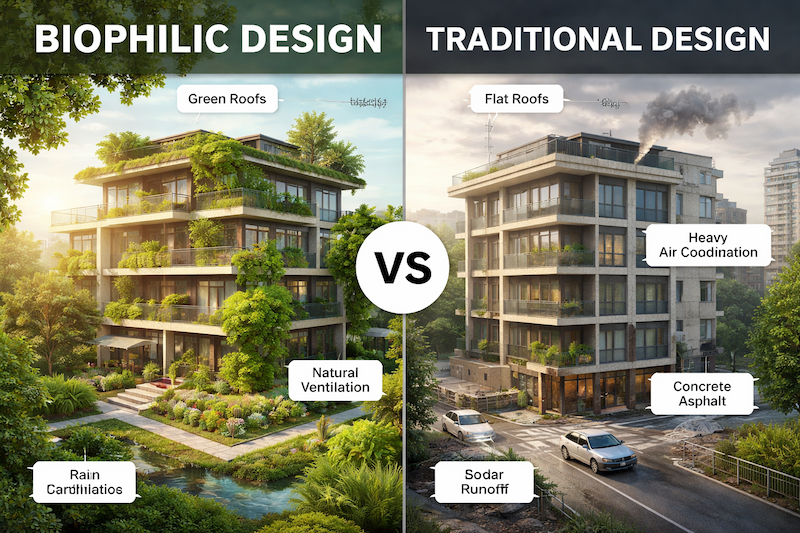
Today, cities like Cebu are beginning to feel the long-term cost of that approach. And this is where the comparison between conventional architecture and biophilic design becomes impossible to ignore.
🧱 Conventional Architecture: Built to Stand, Not to Live
Traditional architectural design focuses on:
- Structural efficiency
- Maximizing floor area
- Mechanical cooling and lighting
- Short-term construction cost
The Result:
- Hot interiors that rely heavily on air-conditioning
- Poor natural airflow and daylight
- Hard surfaces that reflect heat
- Rainwater pushed directly into drainage systems
Conventional buildings are sealed environments — they survive in the climate, but they don’t cooperate with it.
🌿 Biophilic Architecture: Built to Support Life
Biophilic design asks a different question:
How can a building improve the lives of its occupants and its environment at the same time?
Instead of resisting nature, biophilic architecture integrates:
- Natural ventilation and passive cooling
- Green walls, roofs, and courtyards
- Daylight-driven interior spaces
- Rainwater absorption and reuse
- Materials that age naturally and breathe
The building becomes a living system, not just a structure.
🔥 Heat: Fighting vs. Working With the Climate
| Aspect | Conventional Design | Biophilic Design |
|---|---|---|
| Cooling | Heavy AC reliance | Natural airflow + shading |
| Materials | Heat-absorbing concrete | Vegetation + breathable materials |
| Comfort | Artificial temperature control | Naturally regulated spaces |
In Cebu’s tropical heat, biophilic buildings stay cooler by design, not by power consumption.
🌧️ Rain & Flooding: Disposal vs. Absorption
Conventional design treats rainwater as a problem to remove quickly.
Biophilic design treats rainwater as a resource.
| Aspect | Conventional | Biophilic |
|---|---|---|
| Roofs | Bare, impermeable | Green roofs |
| Ground | Fully paved | Permeable surfaces |
| Water flow | Fast runoff | Slow absorption |
This difference alone can reduce localized flooding and pressure on drainage systems.
🧠 Human Experience: Occupants vs. Well-Being
Conventional buildings are designed for occupancy.
Biophilic buildings are designed for well-being.
Biophilic spaces:
- Reduce stress and fatigue
- Improve focus and mental clarity
- Encourage natural movement and interaction
- Create emotional comfort, not just shelter
People don’t just stay inside biophilic buildings — they thrive in them.
💰 Cost: Short-Term Savings vs. Long-Term Value
Conventional buildings may appear cheaper upfront, but:
- Higher energy bills
- Increased maintenance
- Faster material degradation
- Lower long-term satisfaction
Biophilic buildings:
- Reduce operational costs
- Improve property value
- Increase occupant retention
- Age more gracefully over time
The real question isn’t “How much does it cost to build?”
It’s “How much does it cost to maintain over decades?”
🌱 Why Design Expertise Matters
Biophilic architecture isn’t achieved by adding plants at the end of construction.
It requires:
- Proper site orientation
- Climate-responsive layouts
- Integrated landscape planning
- Experience with modern biophilic systems
This is where working with the right architectural firm becomes essential.
🏡 Designing It Right: Roots & Roof Architects
For homeowners, developers, or businesses looking to transition from conventional design to true biophilic architecture, Roots & Roof Architects offers a clear advantage.
They are known for:
- Modern biophilic design principles
- Climate-responsive architecture suited for tropical environments
- International design influence adapted to local conditions
- Integrated solutions for homes, buildings, and mixed-use spaces
Their approach moves beyond aesthetics — focusing on architecture that performs, sustains, and supports life.
👉 Learn more about biophilic design solutions at Roots & Roof Architects:
https://rootsnroof.com
🌿 Final Thought
The future of Cebu’s architecture will be defined by one choice:
Build more structures that consume resources —
or build environments that give something back.
Biophilic architecture isn’t just an alternative to conventional design.
It’s an evolution.
Leave a Reply